Interview
Konrad Krusiewicz
1 Congratulations on winning the MUSE Design Awards! Can you introduce yourself and share about what inspired you to pursue design as a career?
My name is Konrad Krusiewicz. I am an architect, founder, and CEO of The Design Group, a Warsaw based architecture studio specializing primarily in workplace design. My interest in architecture grew out of observation. I have always paid close attention to how spaces are built, how they function, and, above all, how people behave within them. Over time, that curiosity became a professional direction: I wanted to understand why some environments work naturally and others do not. That remains central to the way I approach design. A good interior is not successful because it looks impressive. It is successful when form, function, and human behavior are considered together and the space supports people without forcing them to adapt to it. This is particularly relevant in workplace design, which has been the main focus of my career for many years. An office is not simply a collection of desks, meeting rooms, and technical solutions. It is a place where people spend a significant part of their day, make decisions, exchange knowledge, build relationships, and shape the culture of an organization. That is the perspective we continue to bring to our work at The Design Group.
2 What does being recognized in the MUSE Design Awards mean to you?
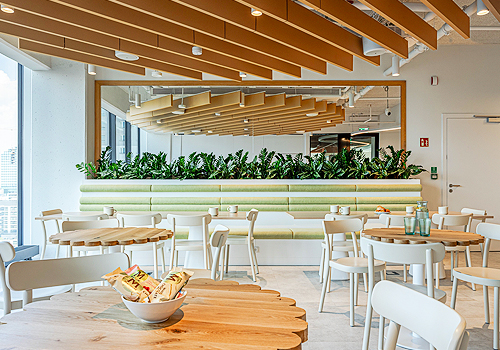
I see this recognition primarily as an acknowledgment of the team and of the quality of the work behind the project. It also confirms that our approach to workplace design can be understood and appreciated in an international context. The office for The Magnum Ice Cream Company was demanding because the brand has a very strong and immediately recognizable identity. Our task was not simply to express that identity visually, but to translate it into architecture without compromising the everyday requirements of a professional workplace. The Serious Playfulness concept gave us a clear framework for doing that. It allowed us to introduce character, energy, and references to the brand while maintaining functionality, comfort, and a coherent spatial structure. For that reason, I consider the MUSE Design Awards Gold to be recognition not only of the final image of the project, but also of the thinking, discipline, and many design decisions that produced it. Architecture is always a collective process. Every completed project is the result of the work of many people, so having that collective effort recognized internationally is particularly meaningful.
3 How has this achievement impacted your career, team, or agency, and what opportunities has it brought so far?
The award is still very recent, so it would be premature to assess its long term impact or to claim that it has already created specific business opportunities. What it has done is give the project and The Design Group stronger international visibility and an additional level of credibility. It allows us to present The Magnum Ice Cream Company office to a broader audience and to place our work within a wider international conversation about workplace design. In the longer term, I would like this recognition to help us reach clients and partners who are looking for ambitious projects and who understand that a workplace should be more than an efficient arrangement of functions. Personally, I treat awards as confirmation rather than as a destination. They are valuable because they show that the direction we have chosen is being noticed, but the priority remains the quality of the next project.
4 What role does experimentation play in your creative process? Can you share an example?
Experimentation is an important part of our process, but it has to be controlled. We do not experiment for effect. We use it to test assumptions, question obvious solutions, and find an answer that is more specific to the client, the place, and the people who will use it. We usually begin with context and function, and then test different interpretations through form, material, color, light, detail, and spatial organization. A bold idea is only valuable if it continues to work when confronted with technical requirements, budget, ergonomics, and everyday use. The Magnum Ice Cream Company office is a good example. With the Serious Playfulness concept, we deliberately avoided treating branding as a layer of logos and graphics added to the walls. We wanted the brand to become part of the architecture itself. The Lick Line emerged from that process. It is a soft, continuous element that changes its role as it moves through the office, appearing in built-in elements, graphics, and lighting. It started as a playful reference to the gesture of licking ice cream, but it became a functional and recognizable part of the spatial language. For me, experimentation is successful when the origin of an idea may be unexpected, but the final solution feels completely natural.
5 What's the most unusual source of inspiration you've ever drawn from for a project?
One of the most unusual sources of inspiration was, quite literally, ice cream. When we designed The Magnum Ice Cream Company’s Warsaw office, we used the world of the brand’s products as raw design material. The important point was not to reproduce the products literally. We looked instead at color, form, texture, layers, and even the physical experience associated with eating ice cream, and translated those qualities into architectural decisions. Vanilla, pistachio, fruit, caramel, and chocolate informed the color and material palette. The geometry of Twister influenced the bases of a custom made high table. An ice cream cone became the starting point for an illuminated acoustic element, while the gesture of licking ice cream developed into the Lick Line. We also used the experience of discovering a product to structure the spatial narrative. The reception is a calmer “unwrapping” moment. Deeper into the office comes the more expressive “first bite,” followed by a gradual reveal of additional colors, forms, and details. What interested me most was that something very ordinary and apparently far removed from architecture could lead to precise, usable design decisions. Inspiration itself is not the value. The value lies in how rigorously it is translated into space.
6 What’s one thing you wish more people understood about the design process?
I would like more people to understand that design starts long before drawing, choosing colors, or selecting materials. It starts with listening, observation, and defining the right problem. This is especially true in workplace design. The finished interior is the visible result of many issues that are largely invisible in photographs: how the organization works, how teams interact, what people need during the day, where friction occurs, how the culture may evolve, and what the building itself allows us to do. On top of that come ergonomics, acoustics, technology, regulations, budget, and program. Good design is therefore rarely one brilliant idea. It is a sequence of hundreds of decisions that need to remain consistent with one another. Some ideas are developed, some are tested and rejected, and some are simplified because the project is stronger without them. The objective is that the final space should feel clear and natural to the user. When that happens, the complexity of the process is almost invisible. In many cases, the more effortless the result appears, the more work has gone into making it so.
7 How do you navigate the balance between meeting client expectations and staying true to your ideas?
I do not see client expectations and our own design position as opposing sides. A strong project should be built from both. Our responsibility as architects is first to understand the client: the organization, its culture, ambitions, operational needs, and the problems the space needs to address. At the same time, the client engages us because they expect professional judgment, experience, and a clear point of view. Our role is therefore not only to propose solutions, but to explain them and take responsibility for the recommendations we make. Differences of opinion are a normal part of that process. They can be productive if both sides are focused on the quality of the outcome rather than on defending an initial position. I do not believe in designing for the architect’s ego, but I also do not believe that an architect should simply execute a wish list. We should ask difficult questions, challenge assumptions when necessary, and propose alternatives when we believe they will produce a better result. The best projects are based on trust. When that trust exists, the distinction between “our vision” and “the client’s expectations” becomes much less important because both sides are working towards the same project.
8 What were the challenges you faced while working on your award-winning design, and how did you overcome them?
The main challenge was to translate a very distinctive and recognizable brand into architecture without making the interior literal or overly branded. The Magnum Ice Cream Company is associated with pleasure, color, flavor, and playfulness, but the project was first and foremost a workplace. It had to perform professionally every day. The design therefore needed to communicate the character of the brand while providing comfort, clarity, acoustics, technology, and the right range of spaces for focused work, collaboration, and larger meetings. Our response was the Serious Playfulness concept. Instead of adding branding after the architectural design was complete, we used the brand’s DNA to inform color, material, light, geometry, details, and the sequence of the space. A second challenge was to ensure that the strongest visual ideas also had an architectural purpose. The Lick Line is not only a graphic gesture; it becomes part of lighting and built in elements. The ice cream cone reference was integrated with an acoustic function, and the Twister inspiration became the geometry of a custom made table. The Town Hall uses movable partitions so that several separate zones can operate independently or become one larger space. The project works when these two layers are not in conflict: the identity of the brand and the practical needs of the people using the office need to reinforce one another.
9 How do you recharge your creativity when you hit a creative block?
When I reach a creative block, I try not to force a solution. In my experience, repeating the same line of thought rarely produces a better answer. I usually change perspective: I step away from the specific problem, look at another scale or another discipline, or simply give myself space to observe something unrelated to the project. Inspiration can come from nature, art, products, everyday behavior, or conversations. I deliberately do not limit it to architecture. I have never had one architectural guru or one source that I return to for answers. I prefer to look broadly because different references create different ways of thinking. Very often, the useful move is to stop looking directly at the problem for a while. When I return to it with some distance, the hierarchy becomes clearer and the solution is easier to identify.
10 What personal values or experiences do you infuse into your designs?
The first value is that architecture should be centered on people. A visually strong interior is not successful if it is uncomfortable, difficult to use, or disconnected from the real needs of its users. The second is consistency. I am demanding about detail, but I do not understand perfectionism as the pursuit of a theoretically perfect space. For me, it means taking responsibility for every decision and making sure that the concept, function, materials, and details support the same overall idea. Years of working with different organizations have also taught me not to rely on universal formulas. Two companies can have a similar headcount and occupy a similar area, yet require completely different workplaces because their culture, work patterns, and expectations are different. Experience has therefore made me more interested in asking precise questions than in applying ready made answers. Ultimately, I want to create spaces that remain useful, understandable, and comfortable long after the opening day. That is a more important measure of quality than the first impression alone.
11 What is an advice that you would you give to aspiring designers aiming for success?
My first advice would be to stay curious and not rush to define your own “style.” A recognizable visual language may come with time, but it should be the result of experience and thinking, not an objective imposed at the beginning of a career. Learn to observe carefully, listen to clients and users, and understand why a solution works rather than simply whether it looks interesting. Look beyond architecture for references and remain open to people who think differently. Every project and every team can teach you something. I would also advise young designers not to treat criticism as a threat. The ability to change your own idea when the evidence shows that it is not working is a professional strength, not a weakness. And finally, do not design only for the photograph. Architecture carries responsibility for how people will use a space over time. If you keep that responsibility in mind, the quality of the work will usually follow.
12 If you could collaborate with any designer, past or present, who would it be and why?
I have never had one architectural guru, so I find it difficult to name a single designer. I have always been more interested in the diversity of thinking than in following one author or one formal language too closely. If I could choose freely, I would probably prefer to collaborate with someone from outside traditional architecture: an artist, a product designer, or a creative from another discipline. For me, the value of collaboration lies in difference. The most interesting partner is not necessarily someone who thinks or designs like I do, but someone who brings a method, sensitivity, or set of questions that I would not have introduced myself. That kind of exchange can challenge habits and open a different way of looking at space. Some of the strongest ideas are created precisely at the point where different disciplines meet.
13 What's one question you wish people would ask you about your work, and what's your answer?
I would like people to ask more often: “How do you know when a workplace design is truly successful?” Our industry naturally focuses on the moment a project is completed. We photograph it, publish it, and submit it to awards. These are important moments, but they do not provide the full answer. The real test begins when the users move in and the architects are no longer present. Then we can see whether people actually choose the spaces we designed, whether they can move between focus and collaboration easily, whether the environment supports interaction without creating disruption, and whether the workplace continues to function as the organization changes. I do not measure success only by aesthetics or by how a project photographs. A successful workplace is one that people understand intuitively, genuinely want to use, and can continue to use well over time. An award is a significant honor, but one of the strongest compliments for an architect is when the design no longer calls attention to itself. The space simply works, and using it feels natural.