Interview
Jacqueline Yu
1 Congratulations on winning the MUSE Design Awards! Can you introduce yourself and share about what inspired you to pursue design as a career?
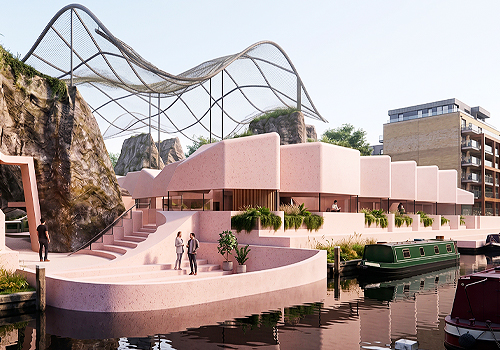
I’m an architect and designer based in the UK, and I’ve always been fascinated by how the spaces around us can influence the way we feel, behave, and connect with one another. I was drawn to design because it sits at the intersection of creativity and everyday life: it allows us to imagine something that doesn’t yet exist, while also having a very real impact on people and communities. Over time, this has developed into a particular interest in designing spaces that invite people to participate rather than simply observe, places that encourage curiosity, play, interaction, and a sense of belonging. I find the most rewarding part of architecture is often not the object itself, but the experiences and relationships it can create. That belief has become an important part of my design approach and is something I continue to explore through my work, including The Playscape Garden.
2 What does being recognized in the MUSE Design Awards mean to you?
Being recognized is incredibly meaningful to me, not only because it celebrates the project, but because it affirms the ideas and values behind it. The Playscape Garden grew from a belief that design can create opportunities for people to explore, interact, and form their own experiences. Receiving this recognition encourages me that an approach centered on play, participation, and human connection can resonate beyond the project’s immediate context. As a designer, I value recognition most when it creates an opportunity to reflect on why we design and what our work can contribute. For me, this award is a reminder to keep questioning conventional approaches, remain curious, and continue creating spaces that are meaningful, engaging, and inclusive. I’m also grateful that the project has the opportunity to reach a wider audience through this recognition. It encourages me to keep developing a design practice that combines imagination with social value, where even relatively small interventions can meaningfully shape people’s everyday experiences.
3 How has this achievement impacted your career, team, or agency, and what opportunities has it brought so far?
For me, one of the most valuable outcomes has been the opportunity to share my project with a broader design audience and to spark conversations about how playful, people centered spaces can be approached through design. It has also been meaningful recognition of the project’s collaborative nature. Although the award is associated with the work itself, projects like this are never created in isolation. I’m particularly grateful to our creative director, Fanqi Yang, who helped bring the idea to life and played an important role in developing and refining it, from polishing the design details to enriching the interior experience and exploring what the project could become. The recognition has given me greater confidence in pursuing design approaches that may be unconventional but are rooted in human experience and social value. Being featured internationally and receiving recognition has also created new opportunities to share the project, including its recent publication by Designboom. Overall, I see this achievement as encouragement to keep exploring ideas that are imaginative, playful, and people centered, and to continue developing a design practice that can create meaningful experiences through space.
4 What role does experimentation play in your creative process? Can you share an example?
Experimentation plays an important role in my creative process because it allows me to question established ways of seeing and understanding space. I’m particularly interested in experimentation when it becomes a tool for research, when making something can reveal a possibility that would not have been visible through conventional methods alone. One example is BODY vs LAND, a wearable forestry survey apparatus I developed as an experimental research project. The project asks whether landscape knowledge can be recorded through movement rather than observation alone. Instead of treating the body simply as an observer, I designed a mechanical apparatus that turns bodily movement into a physical drawing. Wooden and metallic linkages connect to the legs and head, translating walking, climbing, bending, changes in gait, and shifts in gaze into continuous graphic traces on a paper canvas carried within a backpack. A camera simultaneously records the landscape being encountered. What interested me was the possibility of making something as intangible as bodily experience physically legible. The resulting drawings are not conventional maps; they record how terrain affects movement, how obstacles redirect the body, and how attention shifts as we move through a landscape. For me, this project shows why experimentation matters in design. It is not experimentation for its own sake, but a way to ask different questions and develop alternative ways of understanding space. It lets the body become both the researcher and the instrument, turning design itself into a method of investigation.
5 What's the most unusual source of inspiration you've ever drawn from for a project?
One of the most unusual sources of inspiration I've drawn from is Derek Jarman's garden at Prospect Cottage. What fascinated me was not simply the garden's appearance, but the physical acts of tending it, planting, digging, pruning, arranging, moving, and continually responding to the landscape. I became interested in asking whether these everyday gardening actions could themselves become a source of spatial design. Rather than representing the garden literally, I tried to interpret the movements and gestures involved in caring for it and translate them into abstract three dimensional forms. Using visual programming and 3D modeling, I began experimenting with how different gardening actions might be expressed through geometry, movement, and transformation. A gesture such as bending, cutting, digging, or arranging could become an abstract spatial operation, producing a family of forms that captured something about the action without directly illustrating it. I then began to treat these experiments as a kind of spatial library, a collection of abstracted forms and relationships that could be revisited, combined, and transformed as the project developed. In this way, the garden became less an image to reproduce and more a generator of new spatial ideas. I find this kind of translation particularly exciting in design: taking something seemingly ordinary and experiential, such as the act of gardening, and asking how it might become geometry, space, and ultimately architecture. It reminds me that inspiration can come not only from what a place looks like, but from what people do within it.
6 What’s one thing you wish more people understood about the design process?
One thing I wish more people understood is that design is not a one way route. It is rarely a straightforward process of starting with an idea and working toward a predetermined outcome. For me, design is much more iterative and exploratory. You start with a question, an observation, or an intuition, and as you draw, model, test, research, and respond to new information, the project begins to reveal possibilities you may not have anticipated. Sometimes an experiment fails, but that failure can be just as valuable because it tells you something about the direction the project should take. I also think the process is about being willing to change your mind. A strong design is not necessarily the one that follows the original idea most closely, but the one that evolves in response to what you discover along the way. That is why I value experimentation so much in my own practice. Whether I’m working with physical models, digital tools, visual programming, or more unconventional forms of research, I see them as ways of having a conversation with the project. That ongoing dialogue shapes the outcome rather than having it predetermined from the start. Ultimately, I think good design is less about following a fixed path and more about being curious enough to explore where the process takes you.
7 How do you navigate the balance between meeting client expectations and staying true to your ideas?
I see the relationship between client expectations and design ideas as a dialogue, not a conflict. A good design process starts with listening, understanding what the client needs, what they value, and what the project aims to achieve. But I also believe that our role as designers is to look beyond the immediate brief and ask whether there are opportunities to make the project more meaningful, useful, or engaging. For me, the most successful projects are those where the client’s needs and the designer’s ambition strengthen each other. Sometimes that means challenging an assumption, sometimes it means adapting an idea, and sometimes it means finding an unexpected opportunity within a constraint. Ultimately, I see the designer’s role as bringing curiosity and imagination to the conversation while remaining responsive to the people, purpose, and context of the project. When that balance works, the result can become something better than either the original brief or the initial design idea could have produced on its own.
8 What were the challenges you faced while working on your award-winning design, and how did you overcome them?
One of the biggest challenges wasn't necessarily finding the initial idea, but staying consistent as you develop it. Creative projects can begin with a strong moment of inspiration, but turning that idea into something meaningful requires sustained attention, every month, every week, and, in many ways, every day. That consistency taught me that design is often less about one big creative breakthrough and more about the discipline of showing up repeatedly, staying curious, and being willing to refine an idea until it becomes something stronger than where it began. For me, that persistence is an important part of creativity. The final outcome may look like a single finished design, but behind it is a long sequence of small decisions, experiments, and revisions.
9 How do you recharge your creativity when you hit a creative block?
Travelling! I find that being somewhere unfamiliar is one of the best ways to reset my creative mind. Experiencing different cultures, landscapes, architecture, and everyday ways of living constantly gives me new references and perspectives. I love collecting small observations, a color, a material, a street scene, the way people interact with a space, and letting them sit in the back of my mind. Often, they come back later as unexpected ideas in my work. I think creativity needs space to wander, and travel gives me exactly that.
10 What personal values or experiences do you infuse into your designs?
Empathy, curiosity, and a sense of play are at the heart of my designs. I’m inspired by different cultures, places, and ways of living, and I try to stay open minded and look beyond the obvious. Ultimately, I’m interested in creating spaces that bring people together, spark imagination, and create a genuine sense of connection and belonging.
11 What is an advice that you would you give to aspiring designers aiming for success?
I’m still constantly learning too! I would encourage aspiring designers to stay curious, keep experimenting, and not be afraid to make mistakes. Your path doesn’t have to be linear, so keep exploring until you find what genuinely excites you, and let that shape your own voice.
12 If you could collaborate with any designer, past or present, who would it be and why?
Cedric Price would be one of my choices. I’m fascinated by his experimental approach and his belief that architecture should be adaptable, responsive, and shaped by changing social and environmental conditions. This thinking strongly influenced my project, The Flooding School for Amphibious Living, where I explored how architecture might respond to an increasingly uncertain future. I would also love to collaborate with someone like James Dyson. Beyond his approach to design and technology, I admire his willingness to question established solutions, experiment repeatedly, and ultimately turn an idea into something tangible. Bringing these two perspectives together would be fascinating to me, one constantly reimagining what architecture could become, and the other demonstrating how creative ideas can be tested, developed, and brought into the real world. I think that intersection of design, innovation, and entrepreneurship is where some of the most unexpected ideas can emerge and create lasting impacts on people's lives.
13 What's one question you wish people would ask you about your work, and what's your answer?
I wish people would ask me, “Who would you love to collaborate with, and what could you create together?” I believe we should never be afraid to initiate a conversation or reach out to someone whose ideas inspire us. Some of the most exciting possibilities can begin with a simple conversation. We should never underestimate what we can achieve when different perspectives, skills, and ambitions come together to create something bigger than any one of us could imagine alone.