2026 | Professional

Where Land Meets Sky
Entrant
FYOOG
Category
Architectural Design - Public Art & Public Art Installation
Client's Name
Boston Properties
Country / Region
United States
Gallery


About The Entry
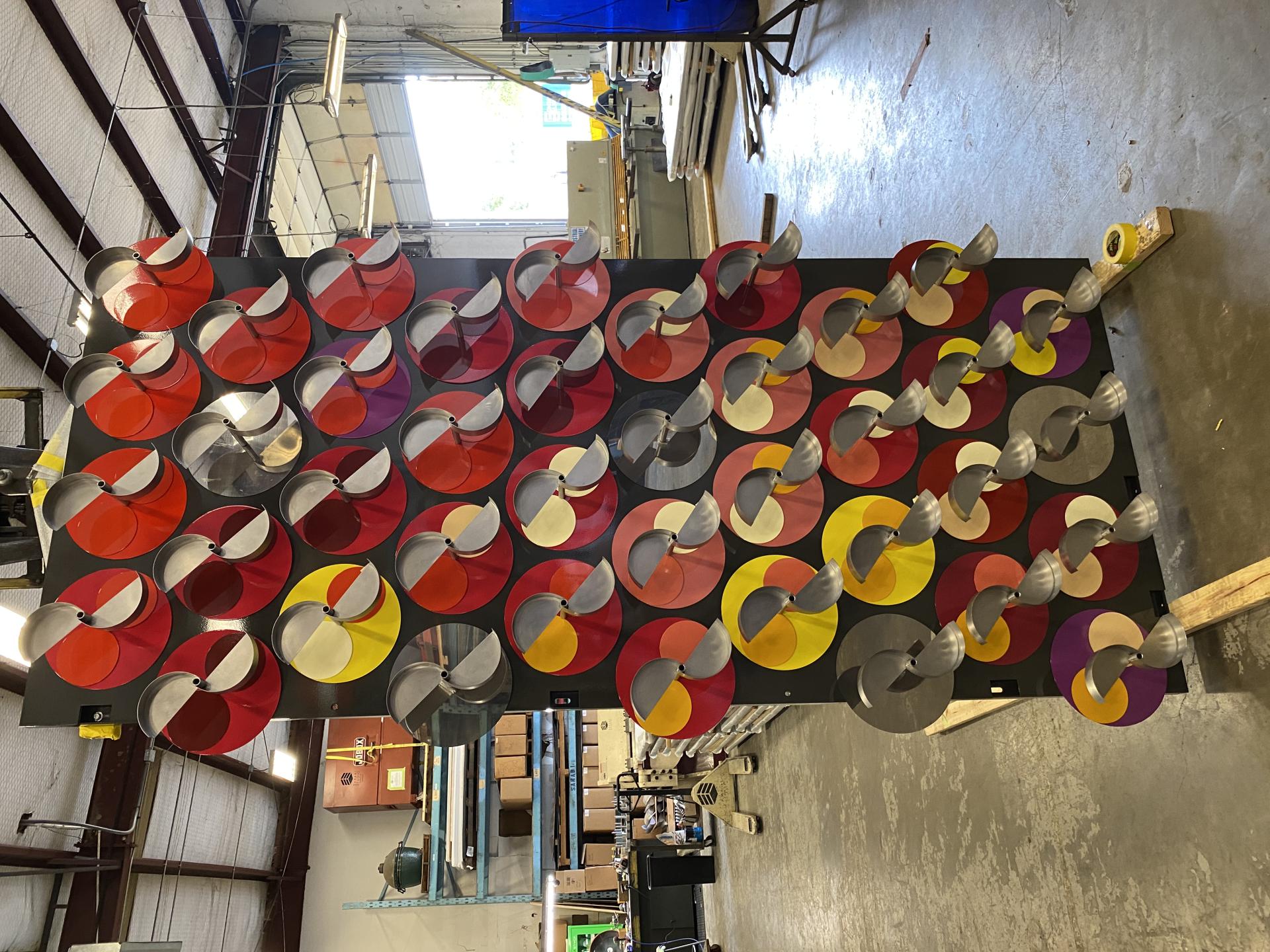
Where Land Meets Sky is a permanent exterior public art installation commissioned for RTC Next in Reston, Virginia, a mixed-use development situated at the edge of the region's urban growth and preserved natural landscape. Composed of approximately 2,000 individual wind-responsive metal elements spanning 112 feet across the building facade, the installation translates the invisible movement of wind into an ever-changing field of reflection, color, and motion visible from across the development and at close range at the pedestrian level. Each element consists of a stainless-steel turbine fitted with powder-coated and mirror-polished stainless-steel discs. As wind moves through the site, the individual components rotate and shimmer, producing fields of reflection that shift continuously with changing wind conditions and light. No two encounters with the work are identical. From a distance the installation reads as a single atmospheric field, its colors and patterns moving in waves across the facade. Up close the mechanical precision of each individual element becomes visible, and the relationship between the work and the environmental forces driving it becomes tangible. The design process began with a fundamental question: would the elements actually move? The site's wind velocities and directions could not be assumed. Before fabrication proceeded, the wind-responsive elements underwent wind tunnel testing to verify their behavior under real site conditions, confirming the installation would perform as designed across the range of conditions the site presents. In parallel, six distinct color pattern configurations were developed and evaluated against changing light conditions and viewing distances before a final composition was selected. At 19.5 feet tall and 112 feet wide, Where Land Meets Sky occupies the full width of the building's primary facade. The work makes visible the atmospheric conditions that are ordinarily felt but rarely seen, inviting viewers to become more attentive to the environmental forces that shape their experience of place. It demonstrates how public art can operate not as an autonomous object applied to a building but as a dynamic system that belongs to both the architecture and the landscape surrounding it.
Credits

Entrant
Shanghai Xubai Technology Co., LTD
Category
Product Design - Textiles / Floor Coverings
Entrant
Shandong University of Art&Design
Category
Transportation Design - Student Design

Entrant
Hsuan Chuang University
Category
Fashion Design - Festive

Entrant
United Nations University Hub at Lingnan
Category
Product Design - AI-Integrated Devices