2026 | Professional

Humen High-Speed Railway Station Expansion Project
Entrant
AEDAS; China Railway Siyuan Survey and Design Group Co.Ltd
Category
Architectural Design - Urban Design
Client's Name
Dongguan Guotie Poly Industrial Development Co., Ltd
Country / Region
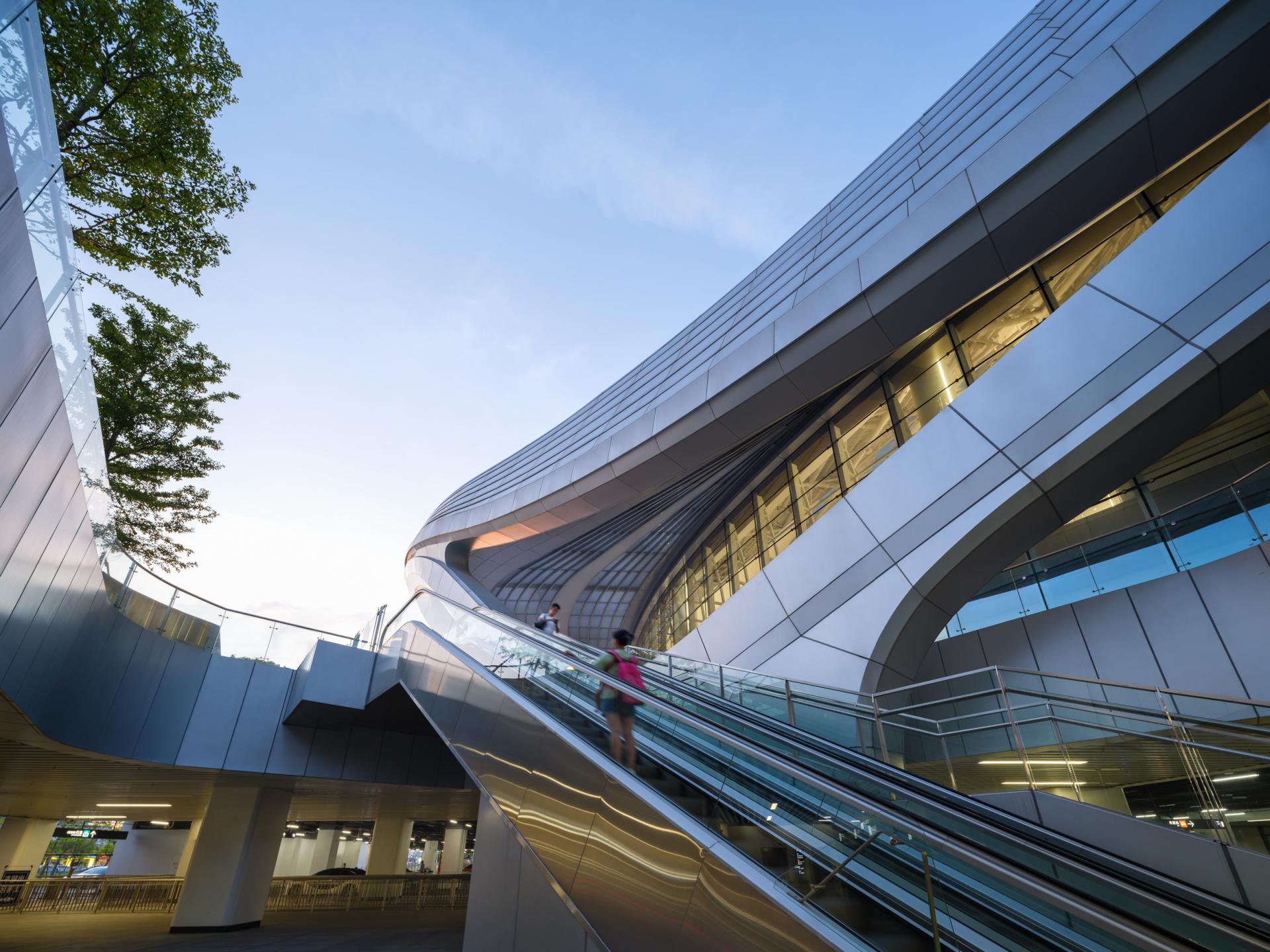
In South China’s high-speed lattice, Humen Station is the busiest, most critical node. Rebuilt without ever closing, it is the Greater Bay Area’s first nonstop rail-hub upgrade and its largest station-led, privately delivered TOD project, resetting regional benchmarks. Once seen as a city “girded by villages,” Dongguan now unveils a silver-wing terminal whose luminous concourse and fused mixed-use podium broadcast international ambition. A year on, 2.2 million Spring-Festival passengers moved through friction-free space once called a “stampede,” turning concrete into the city’s new visual shorthand.
Seamless old-to-new transition
Built for 500 but instantly overwhelmed in 2011, the Humen station had to be rebuilt in place while trains kept running. The 26,000 m² addition drops over the old shell, so the design team embedded transition-phase passenger flows into the concept, compressing structural work into single night shifts. A widened, day-lit atrium, directional façade rhythms and instantly visible escalators let seasoned commuters read the new route on first sight, turning forced migration into intuitive migration.
a building as convincing as the render
The “silver-wing” canopies that reach toward the plaza give new Humen station its signature: a fluid, feather-like roof that shades Dongguan’s heat and rain while V-shaped columns erase excess structure to create an open, flexible hall. CG renderings once sparked skepticism, yet the finished building matches the design—and cost less. Four mirrored steel bays, one repeating curvature, cladding fused to the primary frame and parametric flat-panel skins delivered the double-curve geometry at the industry’s lower unit-price bound, proving elegance can be engineered for the cost of ordinary.
A three-dimensional station-city fabric
“vertical segregation, concentrated transfer, shared infrastructure”—lifts pedestrians to L2, freeing the ground for traffic and creating a shaded “urban living-room” that doubles as film set and festival stage. An airport-style atrium ends disorientation; a joint-cut basement merges rail and city parking, erasing duplicate ramps. The plan flips “station inside, city outside” into a cubic order: station within, city around, above and below. Common tactics individually, they are rarely delivered as one. While construction continues, the decade-long campaign will harden into a regenerative Bay-Area landmark.



Credits
Entrant
Spacewalker Technology (Suzhou) Co., Ltd.
Category
Product Design - Smart Home

Entrant
Tzunuk Studio
Category
Fashion Design - Innovation

Entrant
Aedas
Category
Architectural Design - Renovation
Entrant
Nine Dimension Design
Category
Interior Design - Commercial