Interview
David Jones
1 Congratulations on winning the MUSE Design Awards! Can you introduce yourself and share about what inspired you to pursue design as a career?
My name is David Jones, Creative Director of Minimal Studio. I’ve always been drawn to silence — not the absence of sound, but the presence of control. Design became my way of sculpting that silence into physical form. I never chose design; it chose me the moment I realized that space could feel like emotion, and that geometry could communicate more than words.
2 What does being recognized in the MUSE Design Awards mean to you?
It’s not just recognition — it’s resonance. The MUSE Design Awards represent a dialogue between those who believe that design is more than utility. It’s affirmation that emotional precision and brutalist elegance can coexist and be understood across cultures.
3 How has this achievement impacted your career, team, or agency, and what opportunities has it brought so far?
It amplified our voice. Minimal Studio has always operated from a place of restraint and integrity, and the award validated that philosophy globally. It also opened doors to collaborations with clients who don’t seek decoration, but emotion — people who understand architecture as a language.
4 What role does experimentation play in your creative process? Can you share an example?
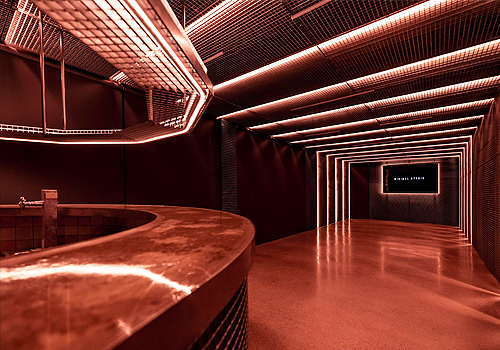
Experimentation is structure disguised as chaos. Every project begins with a hypothesis: what happens if we remove everything except what is essential? For example, in The Light House, we experimented with stacked and polished shipping containers and a central mirror of water that fragmented light into infinite reflections. It was a study of light as material — an experiment in how industry can become poetry.
5 What's the most unusual source of inspiration you've ever drawn from for a project?
Silence. I often find more inspiration in stillness than in visual references. Once, I designed an entire interior after watching the light change on a concrete wall for hours. Inspiration isn’t found — it’s revealed through observation.
6 What’s one thing you wish more people understood about the design process?
Minimalism is not simplicity. It’s control, precision, and depth. Behind every silent space are thousands of decisions — every millimeter is a statement, every shadow intentional. What appears effortless is, in fact, the result of discipline.
7 How do you navigate the balance between meeting client expectations and staying true to your ideas?
We don’t see them as opposites. The real challenge is alignment — when a client understands that our job is not to give them what they want, but what they feel without knowing it. When trust exists, creativity becomes absolute freedom.
8 What were the challenges you faced while working on your award-winning design, and how did you overcome them?
In The Light House, controlling light was both the obsession and the challenge. Working with reflective steel and water meant that even the smallest variation changed everything. We overcame it through precision — measuring, adjusting, and observing until the space stopped resisting and started breathing.
9 How do you recharge your creativity when you hit a creative block?
By disconnecting from design. I ride motorcycles, observe mechanical engineering, and listen to the rhythm of engines. There’s purity in speed — it clears the mind. When you stop thinking about form, form reappears naturally.
10 What personal values or experiences do you infuse into your designs?
Discipline, emotion, and respect for material truth. Every project carries fragments of my life — the rigor of architecture, the solitude of process, and the obsession with time. My work is not about creating; it’s about uncovering what was already there.
11 What is an advice that you would you give to aspiring designers aiming for success?
Learn to be uncomfortable. Great design doesn’t come from confidence; it comes from questioning everything. Embrace mistakes — they’re part of the geometry of evolution. And above all, be honest: design without ego, but with obsession.
12 If you could collaborate with any designer, past or present, who would it be and why?
Carlo Scarpa. His precision was emotional, his silence architectural. He understood that detail is not decoration — it’s destiny. Working with him would be like conversing with time itself.
13 What's one question you wish people would ask you about your work, and what's your answer?
I’d love for people to ask me what my spaces sound like — I’d tell them, “Silence, but not an empty silence. A silence that breathes, that has weight, with the final chords of rock and roll and a hint of heavy metal. That’s the true sound of Minimal Studio.”