Interview
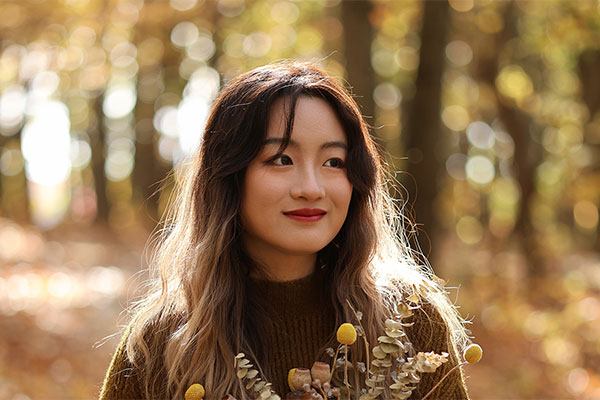
Shuyi Guan
1 Congratulations on winning the MUSE Design Awards! Can you introduce yourself and share about what inspired you to pursue design as a career?
My name is Shuyi Guan, and I am a landscape designer and project manager at SWA/Balsley in New York City, where I work on a wide range of public realm and waterfront projects across multiple scales. Over the past several years, I have contributed to more than twenty projects — from community parks in New York to large international urban developments. My interest in design grew directly from experiencing New York for the first time. The city is incredibly dense and layered, and I quickly noticed how temporary structures like scaffolding shape the atmosphere of streets, the movement of people, and even ecological conditions at the ground level. What many see as visual clutter became, for me, a complex urban system that influences daily life in ways we rarely acknowledge. This realization sparked years of research into how cities might transform overlooked infrastructures into opportunities for environmental repair and public engagement. Before joining SWA, I earned my Master of Landscape Architecture degree from the Rhode Island School of Design, where experimentation and cross-disciplinary thinking are deeply encouraged. RISD shaped the way I approach design as both analytical and imaginative — giving me the tools to question systems and reimagine how cities could function in the future. After returning to New York and joining SWA, that research-driven mindset continued. The curiosity that began with scaffolding and layered city systems now informs my work on large waterfronts, new urban districts, and neighborhood-scale community spaces. The more I engage with built projects, the more I see how this way of thinking supports resilient, adaptable, and environmentally meaningful design. That ongoing connection between research, observation, and real-world implementation is what sustains my commitment to the profession.
2 What does being recognized in the MUSE Design Awards mean to you?
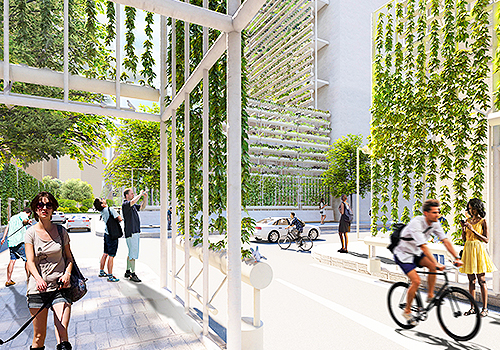
The recognition is meaningful because it affirms the value of looking closely at the ordinary and seeing potential where others might not. Urban Vine grew from years of observing how temporary urban structures influence everyday life and imagining how these overlooked conditions could become opportunities for environmental performance and community benefit. Winning in both Vertical and Green Wall and Sustainable Development shows that these questions matter beyond academic environments. It signals that cities and practitioners are actively seeking new strategies for ecological repair, heat mitigation, and public space enhancement. The award encourages me to continue bridging research and real-world design — especially in dense, rapidly changing urban contexts.
3 How has this achievement impacted your career, team, or agency, and what opportunities has it brought so far?
This recognition helped Urban Vine reach wider audiences through the RISD Museum, the RISD Digital Museum, the Grad Show, and exhibitions connected to my other research work. It renewed attention toward the systems thinking behind the project and highlighted how reimagining everyday infrastructure can strengthen and diversify public space. Professionally, the recognition reinforced my role within SWA as a designer who brings research-driven strategies into complex public realm work. It supports conversations about vertical ecology, ecological retrofits, digital tools, and long-term resilience — all relevant to both international development projects and neighborhood-scale community work. It has also connected me with designers, academics, and institutions who are exploring similar environmental and urban questions.
4 What role does experimentation play in your creative process? Can you share an example?
Experimentation is central to my process. I rarely move directly from an idea to a final design. Instead, I explore through mapping, field observation, analog and digital modeling, and iterative scenario testing — allowing concepts to develop through evidence and imagination at the same time. Urban Vine is a clear example of this method. I began by mapping scaffolding across New York and studying its patterns and impacts. From there, I developed community-scale strategies, environmental performance systems, modular components, and long-term scenarios. Each step tested whether the system could remain adaptable, ecologically meaningful, and logistically feasible. This layered experimentation now guides how I approach complex waterfronts and urban district projects, as well as smaller community-scale spaces.
5 What's the most unusual source of inspiration you've ever drawn from for a project?
One of my most unexpected sources of inspiration has been sidewalk scaffolding. While many see it as an inconvenience, I saw a massive unused surface — one with potential for shade, vegetation, and public life. By studying its patterns and structural logic, and referencing agricultural trellises, hydroponic systems, and temporary spatial structures around the world, I reimagined scaffolding as a platform for ecology and community engagement. This perspective continues to shape how I approach urban design, reminding me to read the city not only for what it is, but for what it could become.
6 What’s one thing you wish more people understood about the design process?
I wish more people recognized how interconnected the design process truly is. A simple final drawing often represents an entire system of hydrology, plant performance, maintenance logistics, safety considerations, community needs, and long-term management strategies. The clarity of a design depends on how well these layers align. In Urban Vine, every component operated within a larger logic involving water cycles, solar energy, modular construction, neighborhood character, and long-term mobility. The apparent simplicity of the final visuals was supported by extensive testing and coordination across scales. This systems-based approach continues to guide all of my professional work.
7 How do you navigate the balance between meeting client expectations and staying true to your ideas?
I begin by understanding the client’s deeper goals — whether they relate to community impact, environmental performance, identity, feasibility, or long-term resilience. Once those priorities are clear, I look for ways creative ideas can meet or even exceed them. Across both international public-realm projects and local park work, I frame design in terms of value: environmental value, economic value, cultural value, and quality of life. When clients see how innovation strengthens longevity, adaptability, and user experience, a shared vision forms naturally.
8 What were the challenges you faced while working on your award-winning design, and how did you overcome them?
The main challenge was shifting the perception of scaffolding from an urban problem to an urban opportunity. Scaffolding is often seen as dark, unsafe, and disruptive. To counter that, I grounded the project in a strong analytical foundation — researching structure, environmental cycles, and public space behavior. Another challenge was integrating multiple systems into a single cohesive framework, including water cycles, hydroponics, solar energy, and plant succession. I developed strategies for different neighborhood types and scales so the system could adapt to varied urban conditions. Approaching the concept with the same rigor as a built project helped make it technically credible and environmentally grounded.
9 How do you recharge your creativity when you hit a creative block?
I go back into the city. Observing how people move through space, how plants grow in unexpected places, and how small improvisations shape daily life helps me see design problems more clearly. I also shift mediums — hand sketching, digital modeling, VR testing, or reading unrelated technical research. Changing perspective allows me to return to the work with fresh clarity.
10 What personal values or experiences do you infuse into your designs?
Repair, accessibility, and adaptability guide my work. Having lived and practiced in different cultural and urban contexts, I’ve seen how quickly cities change and how crucial it is to design with long-term stewardship in mind. Urban Vine reflects my belief that even temporary or overlooked structures can support ecological restoration and social well-being. These values shape how I approach both large international waterfront projects and small neighborhood spaces, always asking how a design can deliver multiple layers of benefit.
11 What is an advice that you would you give to aspiring designers aiming for success?
Treat every project as an opportunity for deep inquiry. Work that begins as a small study or a school assignment can grow into something meaningful when approached with seriousness, curiosity, and rigor. Urban Vine gained strength through extensive mapping, data, environmental analysis, and iterative design. I also encourage designers to notice the ordinary and the imperfect. Many transformative ideas emerge from studying everyday conditions and discovering possibility within constraints.
12 If you could collaborate with any designer, past or present, who would it be and why?
I am interested in collaborating with designers who work at the intersection of ecology, architecture, and public space — people whose projects show how living systems can shape the identity and performance of cities. I value dialogue that connects experimental research with built work, especially when the goal is to improve environmental quality and quality of life.
13 What's one question you wish people would ask you about your work, and what's your answer?
I wish more people would ask how speculative research connects to real-world implementation. For me, the two are inseparable. The thinking that began with Urban Vine now shapes how I approach complex waterfronts, emerging urban districts, and neighborhood-scale parks. Regardless of scale, I apply the same systems-based thinking, the same attention to existing conditions, and the same belief that design should both repair and inspire. My long-term goal is to help cities become more livable and resilient by transforming every layer of the urban environment into an opportunity for ecological and social value.