Interview
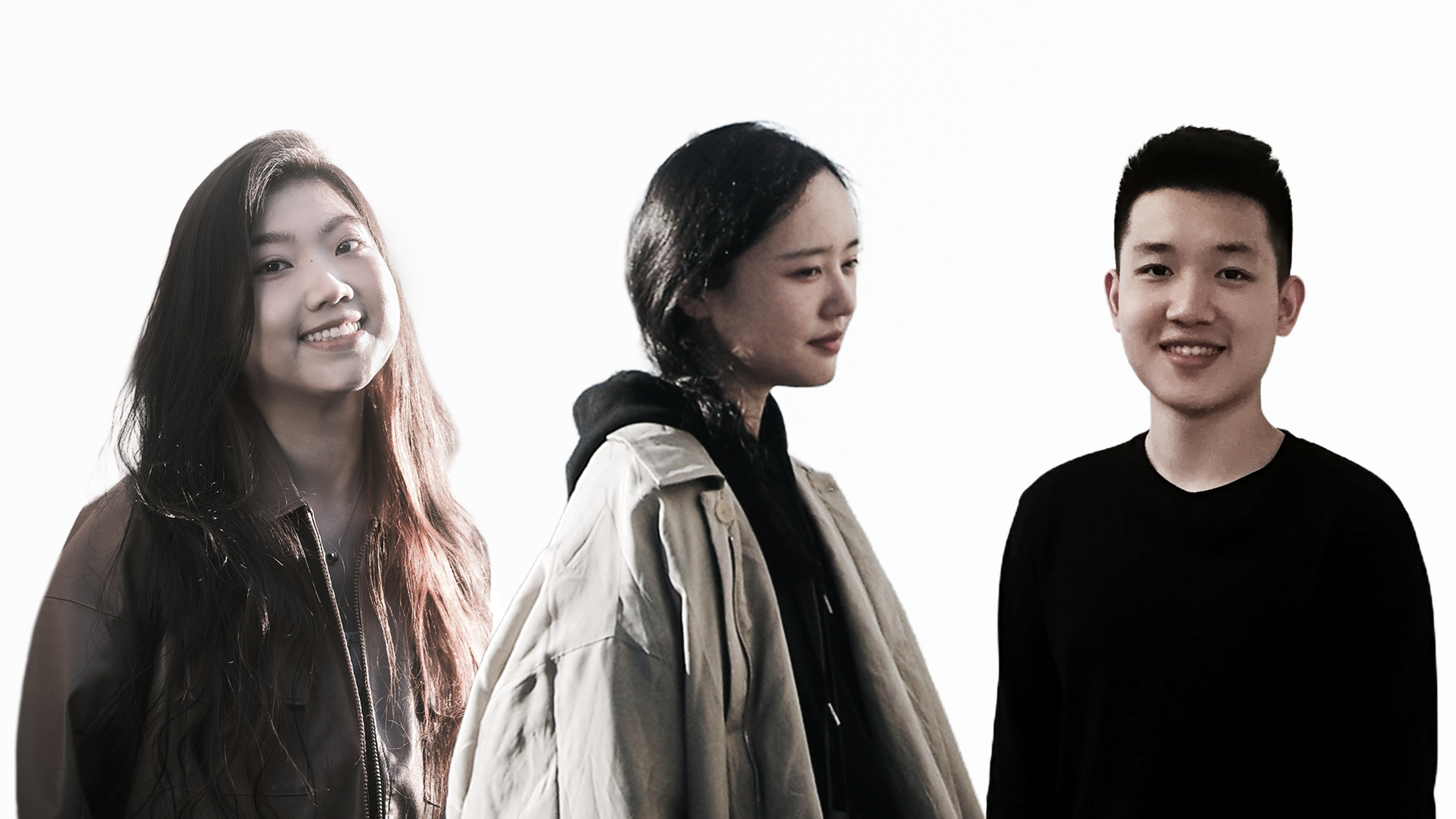
Lume Team
1 Congratulations on winning the MUSE Design Awards! Can you introduce yourself and share about what inspired you to pursue design as a career?
Chengxi: I am an interaction and visual designer who thrives in the liminal space between design and engineering. My journey into design started with a love for technology and a deep admiration for beautifully crafted apps like Things and Bear. The care their creators put into them inspired me to create equally wonderful experiences one day. Zhehan: I'm a digital product designer creating tech products at the intersection of emerging sciences and human experience. Lately, my work explores how generative AI imagery and LLMs can expand what’s possible in fashion and beauty. Design has always felt like a natural home for me. I've always been drawn to making things, from crafting by hand to shaping digital experiences. With a background in data science and machine learning, design gives me a space to balance analytical thinking with emotional creativity. That harmony between logic and humanity is what inspired me to pursue design as a career. Yalai: I'm a product designer based in New York with expertise in financial products, helping people confidently make informed decisions about their money. I started out studying architecture—the art of balancing form and function. While architecture is inevitably constrained to its location, I was drawn to digital design for its broader reach and immediate impact on people's day-to-day lives.
2 What does being recognized in the MUSE Design Awards mean to you?
Being recognized in the MUSE Design Awards is both a milestone and a motivator. It validates the craft and impact of the work, but more importantly, it pushes us to think bigger, take creative risks, and explore challenges that haven’t been solved yet. It’s a reminder to keep raising the bar while staying grounded in creating meaningful solutions for real people.
3 How has this achievement impacted your career, team, or agency, and what opportunities has it brought so far?
The award strengthened our credibility and accelerated our momentum. It validated that our design thinking and execution hold up, which translates to more confidence in balancing the essentials—clarity, usefulness, and restraint. It has also opened more space and support for us to push our AI–human blueprint forward. This recognition has deepened trust from collaborators, tightened our focus, and made it easier to stay aligned on building what truly matters.
4 What role does experimentation play in your creative process? Can you share an example?
Experimentation is how we think: we often start broad, exploring multiple conceptual models of an operating system—each with its own information architecture, interaction grammar, and mental model for AI. Only after stress-testing and learning do we converge on the model that best aligns clarity, capability, and trust. That divergence-then-convergence rhythm keeps our work honest and pushes the invention forward.
5 What's the most unusual source of inspiration you've ever drawn from for a project?
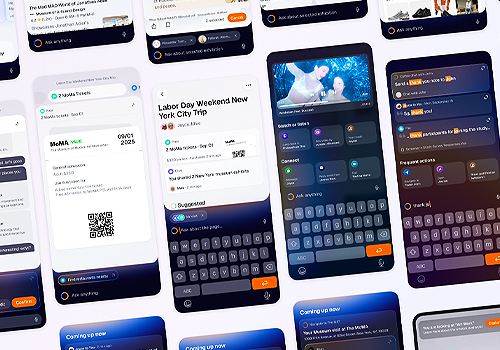
Twilight—those liminal minutes where edges soften and contrast sharpens. We drew our product branding from twilight at sunrise. Lume’s signature blue-orange gradient echoes that soft sunrise glow and inspired the name Lume—it symbolizes the dawn of a new era and visually communicates the intelligence of the AI technologies powering the system, while also evoking warmth and curiosity.
6 What’s one thing you wish more people understood about the design process?
The design process is inherently messy and rarely linear. People imagine a tidy path from brief to solution, but real design loops. You diverge, test, discard, and reframe before converging. The strongest outcomes come from embracing that ambiguity—documenting assumptions, building fast proofs, and letting feedback reshape direction. It’s less a straight line and more a series of calibrated bets that gradually reveal the right answer.
7 How do you navigate the balance between meeting client expectations and staying true to your ideas?
We see client expectations and our ideas as complementary, not competing. The design process is collaborative and participatory: when we invite clients into the work—clarify intentions, align on outcomes, and share designs early and often—we build on their input rather than fight it. That inclusion creates trust, surfaces constraints sooner, and strengthens the solution. Great work happens at the intersection of our creative initiative and the client’s business needs, where vision is translated into measurable impact.
8 What were the challenges you faced while working on your award-winning design, and how did you overcome them?
Our biggest challenge was deciding how AI should exist in the operating system—ambient vs. invoked, how context is understood, and how that understanding is made legible to users in a generative, app‑less environment. We resolved it by prototyping multiple representation and behavior models in parallel, pressure‑testing them against multiple use cases, and converging on design principles that guided us forward.
9 How do you recharge your creativity when you hit a creative block?
Chengxi: I go out, touch grass, watch a movie, or visit a museum. I play—I find that stepping into the world sparks ideas in ways staying at my desk never could. Zhehan: For me, creativity is both serendipitous and subconscious. When I hit a creative block, I’ve learned not to force it. I step away, take a walk without a destination, breathe, feel, and let ideas surface naturally. Often, I return with fresh eyes and a clearer sense of the path forward. Yalai: Sometimes I completely step away from the problem. I’ve discovered that giving my mind permission to wander surfaces connections I couldn’t see when I was too close to the work. Other times, I actively seek inspiration from different fields to uncover new approaches.
10 What personal values or experiences do you infuse into your designs?
Two anchors guide our work: designing trustworthy AI that is transparent, predictable, and clearly augments human intellect; and leveraging our experience designing for commercial user needs for billions of people—prioritising clarity, reliability, and measurable outcomes over cleverness. This approach means creating legible states, giving users agency over automation, and shaping solutions around the real constraints that businesses face.
11 What is an advice that you would you give to aspiring designers aiming for success?
While the definition of success can be varied and personal, we encourage aspiring designers to put in the reps and cultivate taste. Do the work—daily. Ship, critique, refine. Taste comes from exposure and discernment: study great products, dissect why they work, and train your eye to prefer clarity over cleverness. Repetition builds skill; taste directs it.
12 If you could collaborate with any designer, past or present, who would it be and why?
Chengxi: Muriel Cooper. I have long admired her pioneering interaction work during the computer’s early days. I would love to see how, with the advancement of AI, she might continue her mission to build responsive tools and systems and dissolve the boundary between design and production. Zhehan: Hella Jongerius. She blends traditional craft with modern technology, creating objects that feel deeply human. Working with her would inspire me to bring warmth, tactility, and subtlety into the tech-human experience, push the boundaries of emotionally rich and meaningful design, take bold creative risks, and always embrace the new. Yalai: Dieter Rams. His “less, but better” philosophy bridges my architecture background with digital design. He showed that thoughtful, principled design can make complex functionality feel effortless.
13 What's one question you wish people would ask you about your work, and what's your answer?
One question we wish people would ask is: “What vision of human attention guides Lume—and how does it honor agency?” This question sits at the heart of the project’s motivation. Our answer is that Lume treats attention as scarce and meaning‑seeking. By thinking in goals rather than apps, it aligns technology with intention, not impulse. Intelligence becomes a companion—transparent, emotionally aware, and accountable—so users remain the authors of their actions while the system clears the path.