Interview
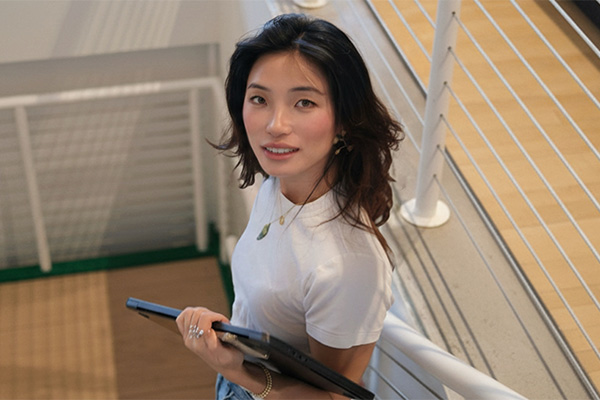
Yamei Liao
1 Congratulations on winning the MUSE Design Awards! Can you introduce yourself and share about what inspired you to pursue design as a career?
I am a New York-based multidisciplinary digital experience designer. My career is rooted in a unique intersection of disciplines: I hold dual degrees — a BA in Economics and a BS in Creative Technology and Design — from the University of Colorado Boulder, followed by an MFA in Design and Technology from Parsons School of Design. This background allows me to combine the rigorous, analytical logic of economics with the experimental, human-centered possibilities of emerging technology. My journey into design was born from the realization that I possess both a rigorous, analytical mind and a sensitive, observant soul. I have always loved deconstructing complex systems while simultaneously seeking the beauty and meaning inherent within them. For me, design is the “bridge” — a vital space where I can connect expressive, beautiful forms with profound strategic purpose.
2 What does being recognized in the MUSE Design Awards mean to you?
This award is a meaningful recognition of the design philosophy I stand for — one that bridges empathy, intelligence, and systems thinking. Seedlings, the awarded project, serves as a powerful demonstration of how AI can move beyond pure utility to support emotional well-being and human connection in pediatric healthcare. Being recognized by the MUSE Design Awards gives me greater confidence to continue architecting a future where design is not only functional but deeply resonant. It affirms the vital importance of thoughtful, human-centered design in the ever-evolving landscape of emerging technologies.
3 How has this achievement impacted your career, team, or agency, and what opportunities has it brought so far?
This recognition has helped bring greater visibility to our work and approach. It has sparked meaningful conversations with collaborators, particularly around how we can make these systems more intuitive and human-centered. Internally, the recognition has also provided me with more opportunities to lead interdisciplinary design sprints and to contribute earlier to the strategic direction of emerging technology projects.
4 What role does experimentation play in your creative process? Can you share an example?
Experimentation is the engine of my design methodology; I treat it as a tool for “prototyping the unknown.” I often work at the frontier where emerging technology and human behavior intersect, dealing with abstract logic that has little existing physical precedent. My process involves rapid, tool-agnostic experimentation, leveraging a comprehensive range of methods. For instance, in my work with August Mille, these experiments were crucial in defining the “behavioral legibility” of autonomous robots, ensuring they operate as predictable and trustworthy partners within our daily social and physical fabric.
5 What's the most unusual source of inspiration you've ever drawn from for a project?
Interestingly, fungi have always fascinated me — not just as biological organisms, but as metaphors for design. They transform decay into renewal, invisibly shaping entire ecosystems. As a designer, I see my role in a similar light. I work quietly within complex systems, translating messy realities into experiences that help people feel safe, understood, and connected. My goal is to be that vital, invisible layer that processes complexity beneath the surface to create growth and connection above it.
6 What’s one thing you wish more people understood about the design process?
I wish people understood that the legendary “aha!” moment is largely a myth. In reality, most great design is never the result of a single flash of inspiration, but rather a rigorous, iterative cycle of continuous observation and critical thinking. Especially when working with complex systems, the “magic” does not happen in a vacuum; it is the visible outcome of a long, invisible conversation between research, prototyping, and testing.
7 How do you navigate the balance between meeting client expectations and staying true to your ideas?
I view every project as a “narrative bridge,” where client goals are treated as strategic inputs rather than constraints. My process relies on proactive communication; I use mood boards, high-fidelity prototypes, mockups, and other visualization tools to educate stakeholders early, transforming abstract ideas into tangible outcomes and effectively managing feedback. Rather than offering a simple refusal, I act as a guardian of the project’s integrity, reframing misaligned requests by linking every design decision back to the business’s long-term success. By focusing on shared goals, such as user trust, I find common ground where innovative vision and practical needs coexist, ensuring a result that is both functional and visionary.
8 What were the challenges you faced while working on your award-winning design, and how did you overcome them?
One of the challenges we faced with Seedlings involved supporting children managing diabetes. The constant need to monitor data can be overwhelming and exhausting for the entire family, creating a heavy emotional burden that I describe as “medical anxiety.” To address this, we built an empathetic layer over the clinical logic. Instead of presenting only cold numbers, we used AI to personalize the experience, transforming stressful daily routines into a rewarding and educational journey. By focusing on “collective agency,” our design helps children and their families feel empowered and in control of their health, rather than feeling like passive patients.
9 How do you recharge your creativity when you hit a creative block?
When I encounter a creative block, I find it essential to step away from the screen and shift my focus entirely to the physical world. Whether it is taking a long walk in nature or observing the quiet details in a gallery, changing my environment helps me move from active problem-solving into a state of sensory observation. I have learned that the best ideas often need room to breathe. By moving my body and engaging with real-world textures, I allow my thoughts to brew in the background. Often, the clarity I need emerges naturally the moment I stop forcing it.
10 What personal values or experiences do you infuse into your designs?
I bring empathy, systems thinking, and a strong sense of responsibility into every project I work on. Growing up across cultures and studying both technology and design have shaped my role as a designer. I value curiosity and humility, which allow me to listen carefully to people, environments, and the systems around them. I see design as a vital form of translation. It connects logic with emotion and transforms complexity into clarity. Especially in AI-related work, I believe designers carry the responsibility to shape how technology makes people feel, not just how it functions. My goal is to ensure that as systems evolve, they remain empowering and deeply respectful of the human experience.
11 What is an advice that you would you give to aspiring designers aiming for success?
Design trends will shift, but the way you see the world is what shapes meaningful work. Instead of asking how to make things look good, ask why something matters to people and how it fits into a larger system. Stay curious, listen well, and build range. The more you understand people, context, and consequences, the greater impact your design can have.
12 If you could collaborate with any designer, past or present, who would it be and why?
I would love to collaborate with Dieter Rams. As Rams once said, “Design should not dominate things, should not dominate people. It should help people; that is its role.”
13 What's one question you wish people would ask you about your work, and what's your answer?
I wish people would ask, “In an automated world, how does this design ensure the user remains the protagonist of their own story?” My answer is that design is the final guardian of ethics in technology. It is about more than efficiency; it is about protecting the user’s sense of self and agency. By intentionally shaping how AI behaves and communicates, we are doing more than building products — we are defining the kind of future society we want to live in.