Interview
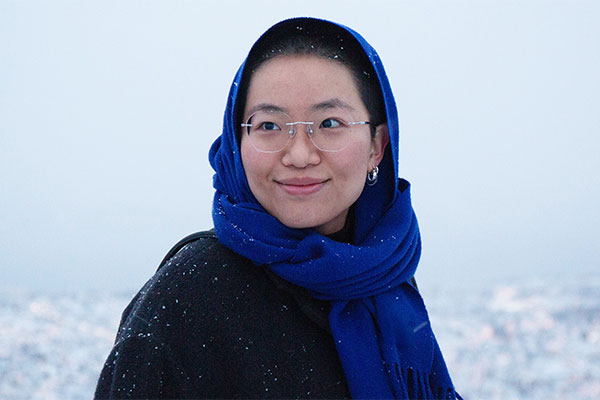
Xubai Li
1 Congratulations on winning the MUSE Design Awards! Can you introduce yourself and share about what inspired you to pursue design as a career?
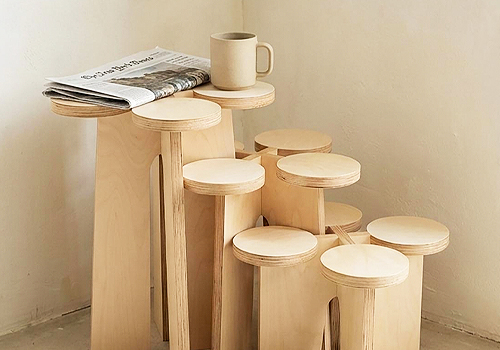
My background is in graphic design and branding, but my graduate studies led me toward object-making and spatial design. I was inspired early on by a Henry Moore sculpture I encountered in childhood. Its tenderness, spatial serenity, and sculptural presence showed me how art and design can intersect, inspiring me to create objects that occupy space with conceptual depth rather than simply serving as functional furniture.
2 What role does experimentation play in your creative process? Can you share an example?
Experimentation is critical to my creative process, particularly through digital fabrication. I rely on 3D modeling and 3D printing to produce small-scale prototypes and testing samples. This iterative approach allows me to evaluate visual elegance, proportion, spatial interplay, and the subtle balance of asymmetrical compositions before committing to full-scale production.
3 What's the most unusual source of inspiration you've ever drawn from for a project?
I draw inspiration from a wide range of disciplines, an approach that is not always common in industrial design. For example, my light switch, Turn On Light, shares a formal dialogue with the avant-garde fashion language of Maison Margiela. I am also deeply influenced by ancient Chinese texts, which I use as a lens through which to examine Western design movements such as modernism and postmodernism. This cross-cultural perspective allows me to explore ideas of metamodernism and their expression within my work.
4 What were the challenges you faced while working on your award-winning design, and how did you overcome them?
The core challenges in my physical design work are twofold. First, there is the inevitable gap between imagination and physical realization, which I view as an opportunity to learn and refine the work. Second, there is the reality of manufacturing timelines, which often depend on the reliability and collaboration of production partners. I address conceptual challenges through extensive prototyping and testing during the stages of the process that are within my control.
5 How do you recharge your creativity when you hit a creative block?
When I encounter a creative block, I choose to rest and consciously step away from creating. The mind and body are deeply connected; if they are kept under constant tension, like a bow pulled too tightly for too long, their strength and flexibility eventually fade. Letting go of the expectation that I must always be producing, and intentionally making space to simply wonder, is how I recharge and reconnect with creativity.
6 What personal values or experiences do you infuse into your designs?
I draw inspiration from my cultural heritage, though not through direct visual symbols such as yin and yang. Instead, it is expressed through ideas, values, and ways of thinking that inform my design approach. As I explored in my thesis, Out of Consumption, Out of Context, Into Recursion, I bring a multidisciplinary perspective that bridges my cultural background with contemporary structural design, creating work that connects tradition and innovation in subtle but meaningful ways.
7 What is an advice that you would you give to aspiring designers aiming for success?
Embrace a multidisciplinary approach and view art and design as interconnected practices. As AI and automation continue to master increasingly specialized tasks, the greatest value of human creativity will lie in the ability to form unexpected connections across disciplines. The true strength of a designer is not specialization alone, but the capacity to draw abstract, conceptual, and creative links between seemingly unrelated fields. Cultivate a broad perspective, stay curious, and avoid limiting yourself to a single way of thinking.
8 If you could collaborate with any designer, past or present, who would it be and why?
When I encounter a creative block, I choose to rest and consciously step away from creating. The mind and body are deeply connected; if they remain under constant tension, like a bow drawn for too long, their strength and resilience begin to fade. Letting go of the expectation that I must constantly produce, and intentionally making time simply to wonder, is how I recharge. Those moments of pause often create the space needed for new ideas to emerge naturally.