2026 | Student

Recombine, Resolve, Revive
Entrant
Shuo Han
Category
Landscape Design - Regenerative Landscape Design
Client's Name
-
Country / Region
China
Gallery



About The Entry
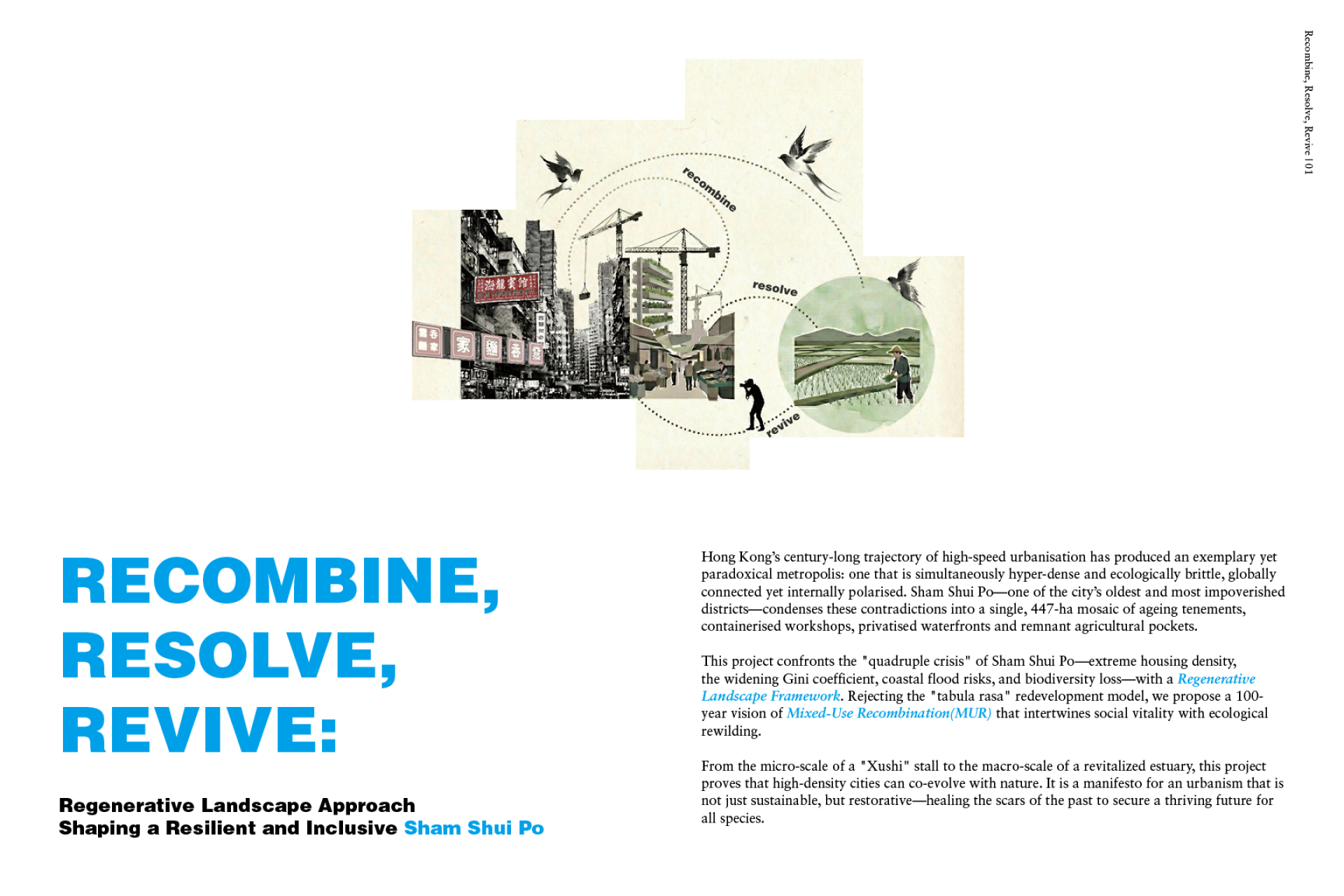
Recombine, Resolve, Revive: Regenerative Landscape Approach Shaping a Resilient and Inclusive Sham Shui Po
Hong Kong’s century-long trajectory of high-speed urbanization has produced an exemplary yet paradoxical metropolis: one that is simultaneously hyper-dense and ecologically brittle, globally connected yet internally polarized. Sham Shui Po—one of the city’s oldest and most impoverished districts—condenses these contradictions into a single, 447-ha mosaic of ageing tenements, containerized workshops, privatized waterfronts and remnant agricultural pockets.
This project confronts the "quadruple crisis" of Sham Shui Po—extreme housing density, the widening Gini coefficient, coastal flood risks, and biodiversity loss—with a Regenerative Landscape Framework. Rejecting the "tabula rasa" redevelopment model, we propose a 100-year vision of Mixed-Use Recombination(MUR) that intertwines social vitality with ecological rewilding.
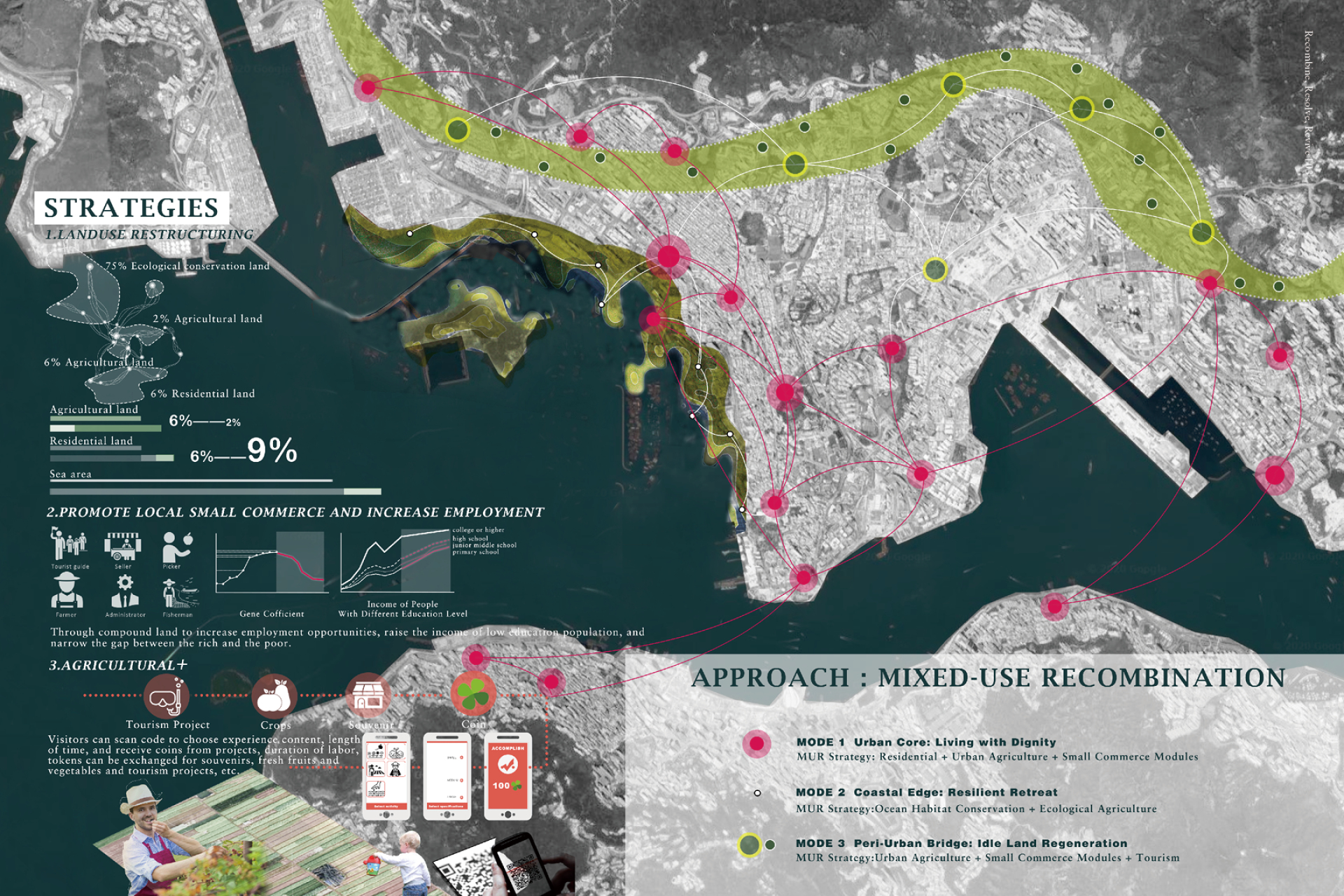
Our strategy unfolds through three adaptive modes:
1. Mode1—Urban Core (Living with Dignity): Addressing food insecurity and the indignity of "coffin homes" , we insert "Agri-Commerce" modules into the dense fabric. These low-cost, solar-powered infrastructures enable vertical farming and revive "Xushi" (墟市)—traditional market culture. By formalizing informal vending spaces, we preserve intangible heritage and provide critical livelihood opportunities for the working poor, directly narrowing the wealth gap.
2. Mode2—Coastal Edge (Resilient Retreat): In a bold response to climate change and the collapse of the Chinese White Dolphin population, we propose Managed Retreat and De-reclamation. We advocate for the phased removal of hard industrial coastlines, returning land to the sea to restore the "rugged" estuarine topography essential for dolphin breeding. This creates a "sponge" buffer against storm surges, transforming the threat of sea-level rise into an opportunity for seawater agriculture and marine conservation.
3. Mode3—Peri-Urban Bridge (Idle Land Regeneration): We activate abandoned fringe lands for agritourism, with small commerce for both the community and the tourists, utilizing a circular "sightseeing economy" to bridge the urban-rural divide.
From the micro-scale of a "Xushi" stall to the macro-scale of a revitalized estuary, this project proves that high-density cities can co-evolve with nature. It is a manifesto for an urbanism that is not just sustainable, but restorative—healing the scars of the past to secure a thriving future for all species.
Credits
Entrant
Zhejiang Kalayang Luggage and Bag Company
Category
Product Design - Travel Accessories

Entrant
Shantou Luoqi Guohan Clothing Co., Ltd.
Category
Fashion Design - Sleepwear

Entrant
LIN,YONG-YI
Category
Interior Design - Living Spaces

Entrant
Chaoming Li
Category
Landscape Design - Urban Design