2026 | Professional

Wide Light
Entrant
Yifeng Interior Design
Category
Interior Design - Residential
Client's Name
-
Country / Region
Taiwan
Gallery


About The Entry
A large amount of natural daylight enters the residence through the dining and kitchen area, and the designer chose to amplify this inherent advantage. From the early planning stage, the team recognized the critical importance of spatial configuration: if light were blocked too early, the perceived scale of the interior would be instantly compressed. Therefore, the core design concept centered on allowing light to remain unhindered and continuous throughout the space.
In this project, the kitchen is not merely a functional zone, but the starting point that receives and carries light. The living room, through the visual composition of the TV wall, becomes the terminal point where light settles. Light begins at the window, travels through the dining and kitchen areas, slips through the gaps between cabinetry, and finally pauses in the living room, completing a calm and coherent daily living path.
The first spatial transition occurs at the entryway. Floor-to-ceiling storage cabinetry integrates shoe storage and miscellaneous functions, while a hollowed middle section releases visual pressure, allowing residents to glimpse the dining area’s floor-to-ceiling windows and natural light upon entering. Storage is no longer treated as a closed mass, but instead becomes a conduit for both light and sightlines.
The television wall employs vertical wooden slats paired with linear lighting to elongate wall proportions and soften horizontal constraints, creating a more slender and composed spatial impression. Adjacent to this, the refrigerator is fully concealed within integrated cabinetry, forming a “breathing pause” between the living room and kitchen. This design maintains a subtle boundary between zones without disrupting the overall sense of openness.
Within the dining and kitchen area, the preparation counter and island bar are designed as a shared configuration. This approach improves spatial efficiency while allowing food preparation, dining, and conversation to naturally overlap. Storage is incorporated beneath the bar counter, ensuring daily items are neatly organized and the space remains consistently uncluttered and orderly.
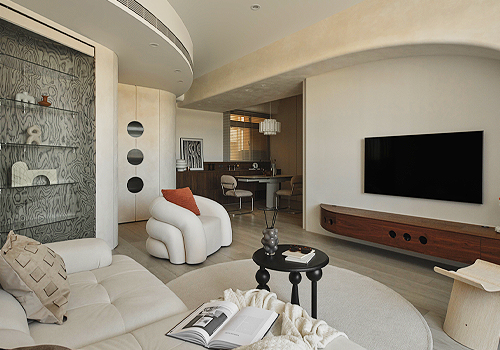
Entrant
Naaa.ge Interior Design
Category
Interior Design - Residential
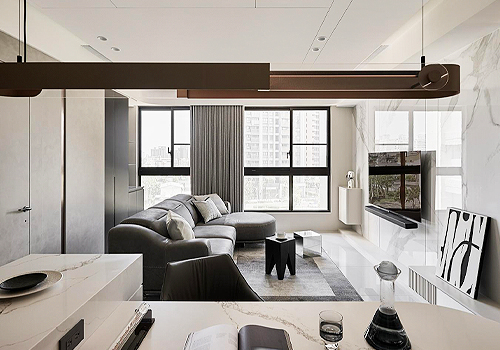
Entrant
Hundred Nest Interior Studio
Category
Interior Design - Residential

Entrant
Shanghai Hong'ao Advertising Co., Ltd.
Category
Packaging Design - Snacks, Confectionary & Desserts
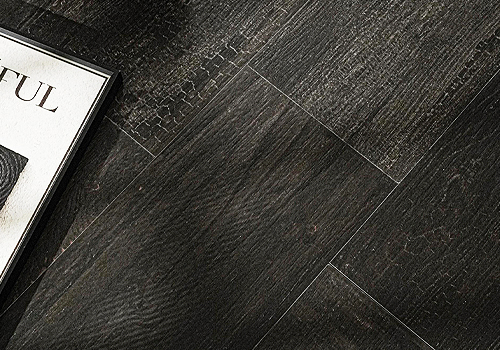
Entrant
FOSHAN I-ONE Building Materials Co., Ltd.
Category
Product Design - New Category